A near infrared panel review should answer more than one question: does the device turn on and feel warm? For people investing in recovery at home, a private wellness room, a hotel suite, or a professional practice, the real question is whether the panel delivers a consistent, comfortable, and practical photobiomodulation experience worth building into a routine.
Near-infrared light panels are designed to support the body’s natural recovery processes with specific bands of red and near-infrared light. The category has expanded quickly, which makes careful evaluation essential. A larger panel, a longer specification sheet, or an intense marketing claim does not automatically mean a better daily wellness tool.
Near Infrared Panel Review: What Should Be Evaluated?
The most useful way to assess a panel is to look at the whole experience: light quality, output, coverage, controls, construction, and how easily it fits into real life. A device can have impressive technical figures yet be awkward to position, uncomfortable to use, or too narrow in coverage for the intended purpose.
For home users, simplicity and consistency often matter most. For spas, rehabilitation centers, and hospitality settings, durability, presentation, sanitation, and a clear client experience matter just as much. The right panel should feel considered rather than overly clinical or complicated.
Start with wavelengths, not marketing language
Photobiomodulation panels commonly combine visible red light with invisible near-infrared light. Red wavelengths are often used for surface-level applications, while near-infrared wavelengths penetrate more deeply into tissue. Together, they are intended to support cellular energy production and the body’s normal regenerative response.
Many quality panels use wavelengths in the red range around 630 to 660 nanometers and near-infrared ranges around 810, 830, or 850 nanometers. There is no single perfect wavelength for every person or goal. What matters is that the manufacturer clearly identifies the wavelengths used and explains why they are included.
Be cautious with vague statements such as “full-spectrum therapeutic light” if no wavelength information is provided. A premium wellness product should make its fundamental technology understandable. Clear specifications are not a substitute for quality, but they are a basic sign of transparency.
Irradiance matters, but more is not always better
Irradiance describes the amount of light power reaching a surface, usually expressed in milliwatts per square centimeter. It helps determine how long a session may need to be and whether the panel can provide meaningful exposure at a practical distance.
This figure needs context. Measurements can vary depending on distance, meter type, beam angle, and whether the reading represents a central hot spot or a broader average. A dramatic number measured directly against the LEDs says little about the experience at a realistic treatment distance.
A well-designed panel provides useful output without forcing the user to stand uncomfortably close. It should also offer sensible guidance for distance and session duration. Very high intensity is not automatically an advantage because photobiomodulation is dose-dependent. More exposure is not necessarily better exposure.
Coverage Determines Everyday Value
A small panel can be an excellent choice for localized use on an area such as a shoulder, knee, or lower back. It is portable, easier to store, and usually less expensive. The trade-off is time. Treating multiple body areas with a compact device can turn a quick recovery ritual into a lengthy sequence.
Medium and full-body panels offer a more efficient approach for people who want to support general recovery, muscle relaxation, sleep routines, or post-exercise care. They are particularly relevant in premium wellness settings where the experience should feel calm and uninterrupted rather than pieced together.
Before choosing a size, consider where the panel will live. Measure the available wall, floor, or door space, and think about whether users will sit, stand, or lie down during sessions. A panel that fits the room and the routine will be used far more consistently than one that feels like equipment to manage.
Build quality is part of the treatment experience
A near-infrared panel should be stable, quiet, and intuitively controlled. Check the quality of the housing, mounting options, cable placement, cooling system, and controls. Fan noise can be especially relevant in bedrooms, treatment rooms, and hotel environments, where the goal is restoration rather than distraction.
Separate controls for red and near-infrared light can be useful, although they are not essential for every user. Timers are highly valuable because they encourage consistent sessions and prevent accidental overuse. Adjustable intensity may also help professionals tailor the experience for different client preferences and room layouts.
For commercial use, consider whether the design supports repeated daily use and straightforward cleaning. The visual character matters, too. In a refined space, wellness technology should contribute to the atmosphere rather than interrupt it.
Safety and Comfort Are Non-Negotiable
Near-infrared light is invisible, so users may not always recognize how much energy is being delivered simply by looking at the panel. Follow the manufacturer’s instructions on distance, duration, and eye protection. Bright red LEDs can be visually intense, and dedicated eye protection is a sensible choice, particularly when the face is close to the device.
People with photosensitivity, those taking medications that increase light sensitivity, and anyone managing a health condition should consult a qualified healthcare professional before beginning a light-based routine. This is especially relevant for professional providers who need clear client screening and usage protocols.
A credible panel brand avoids presenting photobiomodulation as a cure. It is a non-invasive wellness technology that may support recovery, relaxation, and daily well-being when used thoughtfully. It does not replace medical diagnosis, treatment, movement, sleep, nutrition, or professional care.
Features That Deserve a Closer Look
Some features add genuine practical value. Others primarily create an impressive-looking product page. Timers, dimming, independent channel controls, reliable mounting, and low-noise cooling usually improve ownership. A comfortable stand or an easy wall-mount system can be more valuable than an extra decorative lighting mode.
Pulsing is one feature that deserves perspective. Some users and professionals prefer pulsed light protocols, but it should not be treated as a universal requirement. The evidence and ideal settings depend on the intended use, and a panel should not be chosen on pulsing alone.
Likewise, a large number of LEDs does not tell the complete story. LED quality, beam distribution, thermal management, electrical design, and usable coverage all influence performance. Ask how the panel performs in a full session, not just how it appears in a specification table.
Matching the Panel to the Setting
For a personal recovery space, the best choice may be a medium panel with a timer, adjustable intensity, and a convenient mounting solution. It can support a repeatable ritual after training, during a wind-down routine, or at the start of the day.
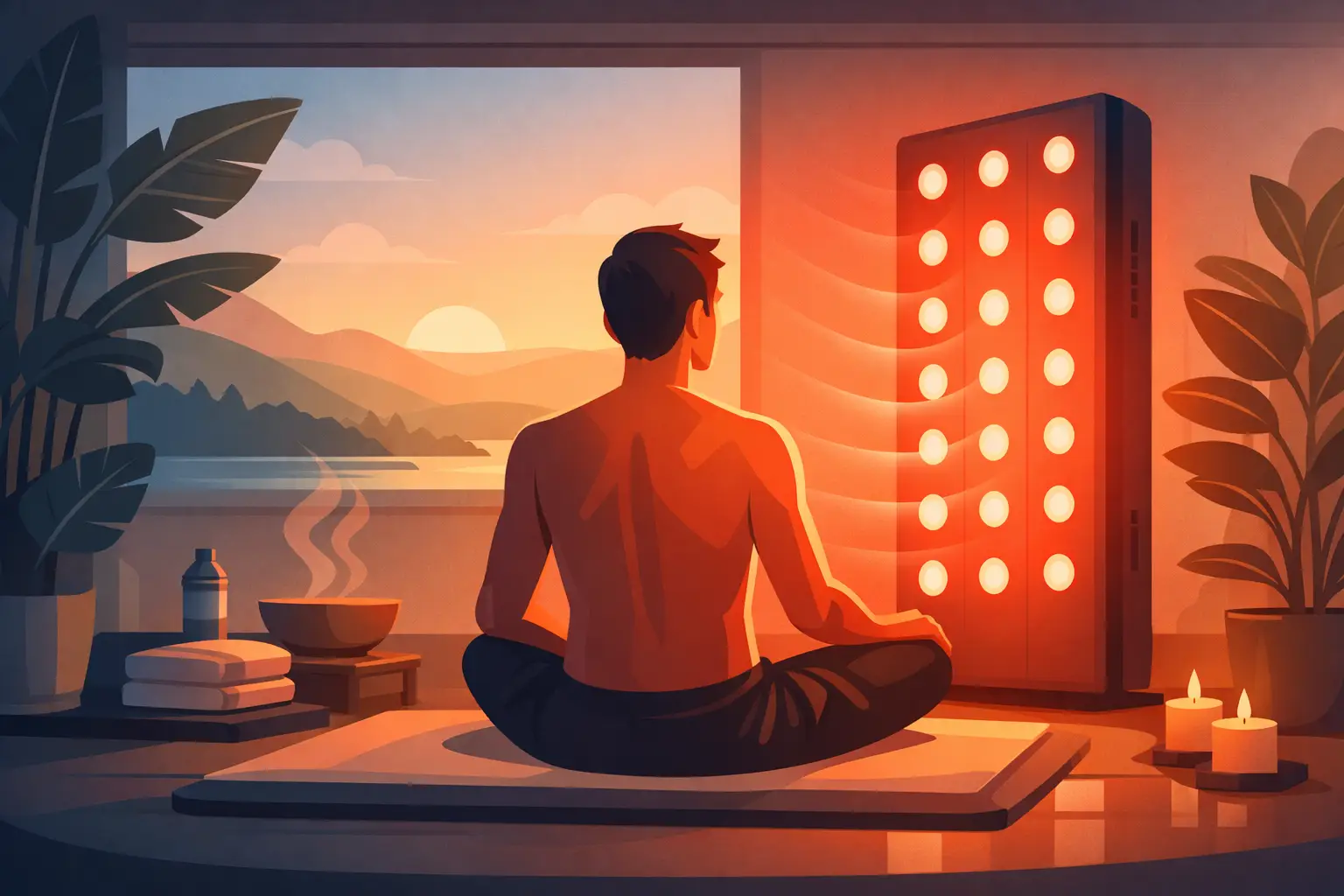
For a spa, clinic, or hotel, a larger and more refined installation may make better sense. The objective is not only light delivery but an environment that supports calm, privacy, and confidence. This is where an integrated approach has real value: a panel becomes part of a complete regenerative setting rather than a standalone device placed in a corner.
HealthWise approaches this idea through premium wellness environments that connect advanced red and near-infrared photobiomodulation with the wider quality of the space around the user. For guests, clients, and families, that makes recovery feel natural, elegant, and easier to sustain.
The Better Buying Question
Instead of asking which panel is the most powerful, ask which one you will use consistently and confidently. Look for transparent wavelength information, realistic irradiance guidance, coverage that matches your goals, thoughtful controls, and a design that belongs in your environment.
The best near-infrared panel is not the one with the loudest promises. It is the one that makes a credible recovery practice feel simple enough to become part of ordinary life.