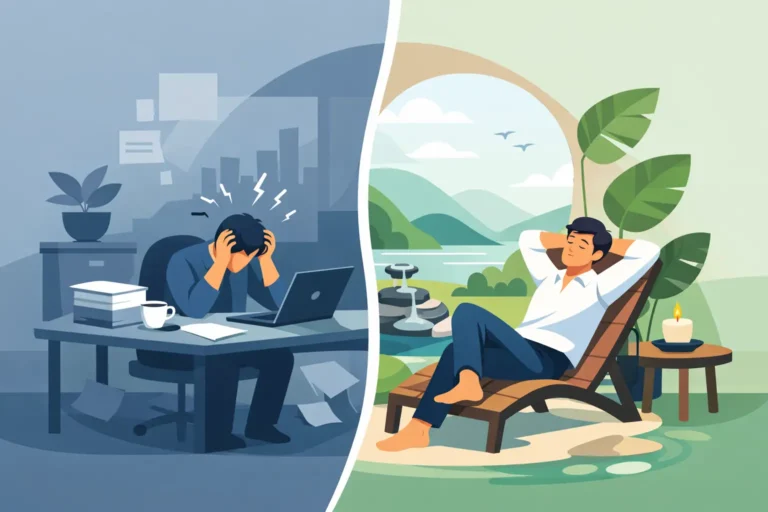

A demanding presentation at 2:00 p.m., a full inbox, and a noisy office can make concentration feel like a limited resource. The question is not simply how to push people to work harder. It is how to create conditions that help the mind settle, recover, and return to the task with greater clarity. That is how wellness rooms improve focus: they give people a purposeful environment where sensory overload can ease and restorative routines become part of the workday.
For businesses, hotels, wellness professionals, and private households, a well-designed wellness room is not an ornamental amenity. It is a practical response to the physical and mental demands of modern life. When the surrounding environment supports calm breathing, visual comfort, and restorative pauses, focus becomes easier to sustain.
Focus Is an Environmental Outcome
Focus is often treated as a personal discipline problem. Certainly, habits matter. Sleep, hydration, movement, and task management all influence cognitive performance. Yet the setting matters just as much. Bright screens, artificial light, stale-feeling rooms, interruptions, and persistent stress can keep the nervous system in a state of alertness that makes deep concentration more difficult.
A wellness room creates a deliberate contrast to that pressure. It is a dedicated space designed for a short reset rather than another stream of inputs. The goal is not to make people passive or disconnected from their responsibilities. The goal is to help them return to those responsibilities less mentally crowded.
This distinction matters in high-performance environments. A quiet, restorative space can support an employee between meetings, a hotel guest recovering from travel, a therapist preparing a client experience, or a parent seeking a more balanced rhythm at home. The value lies in making recovery accessible before exhaustion becomes the default.
How Wellness Rooms Improve Focus Through Better Recovery
The brain does not perform at its best when every moment is spent responding. Attention needs intervals of release. A wellness room provides those intervals by reducing unnecessary stimulation and giving the body a consistent signal that it can slow down.
Even a brief session can be useful when it replaces scrolling, rushing, or sitting in a noisy break area. A person may use the room before a complex task, after a difficult call, during a travel-related energy dip, or at the end of a demanding shift. Over time, this practice can help establish a more sustainable relationship between effort and recovery.
The effect is not identical for everyone. Some people need ten quiet minutes to feel reset; others benefit more from a longer, scheduled wellness routine. The important factor is consistency. When a restorative environment is easy to access, people are more likely to use it before stress has fully accumulated.
A Calmer Sensory Landscape
A focused mind benefits from fewer competing signals. Wellness rooms typically work best when they avoid visual clutter, unnecessary noise, harsh lighting, and the expectation that someone must remain available. The room should feel intentional, private, and easy to use without preparation.
Light is especially influential. Harsh overhead lighting can contribute to visual fatigue, while a carefully considered lighting environment can make a room feel more settled and comfortable. Red and near-infrared photobiomodulation is increasingly integrated into premium wellness settings as a non-invasive modality that supports recovery routines. Its purpose is not to replace medical care or promise instant mental performance. Rather, it can be part of an environment designed around restoration, comfort, and everyday vitality.
A calmer sensory setting does not eliminate a demanding workload. It changes the quality of the pause between demanding moments. That can make it easier to re-enter work with steadier attention and less reactive energy.
Breathing, Comfort, and Mental Clarity
People often notice the quality of a room before they consciously think about it. A space that feels fresh, balanced, and nature-connected can encourage people to stay longer, breathe more slowly, and settle into a restorative state.
Nature-inspired air revitalization brings another dimension to the wellness-room experience. Forest Air’s light-activated approach is designed to support a more revitalizing indoor atmosphere, aligning a modern space with the sensory associations people have with time spent in natural environments. For many users, this can make a wellness session feel more complete than simply sitting in a dark, quiet room.
The practical benefit is straightforward: when a person feels physically more comfortable, it is easier to give attention to one thing at a time. This is particularly relevant in offices, rehabilitation settings, and hospitality spaces where guests or staff may already be carrying fatigue, travel stress, or sensory overload.
The Best Wellness Rooms Have a Clear Purpose
A wellness room should not be designed as a vague relaxation zone. The strongest spaces have a defined use case and an experience that makes sense within the user’s day.
In an office, that may mean a private room for 15- to 20-minute recovery sessions between intensive work blocks. In a hotel, it may be a premium in-room or dedicated experience that helps guests decompress after travel and sleep more comfortably. In a spa or rehabilitation center, it may complement existing recovery protocols with a non-invasive, technology-supported environment.
Design choices should follow that purpose. If the room is intended for quick daytime resets, it needs to be intuitive and available without a complicated booking process. If it is part of a longer wellness journey, seating, lighting programs, session guidance, and staff education deserve more attention. A beautiful room that is difficult to use will not produce meaningful value.
Privacy Builds Trust and Use
People rarely recover well when they expect to be interrupted. Privacy is therefore a functional feature, not a luxury detail. A wellness room should offer users a clear boundary from the pace and visibility of the main environment.
For employers, this also means creating a culture that permits recovery. If staff feel that taking a 15-minute wellness session appears unproductive, the space may remain unused. Leadership can change that by framing focused recovery as part of sustainable performance rather than an exception to work.
Hotels and wellness operators face a similar consideration. Guests need simple guidance on what the experience is, how long it takes, and what they can reasonably expect. Clear communication increases confidence while avoiding exaggerated claims.
Technology Works Best When It Feels Natural
Premium wellness technology should add value without making the room feel clinical or complicated. The most effective environments translate advanced systems into a simple human experience: enter, settle, breathe, recover, and return to the day.
This is where integrated concepts have an advantage over isolated devices. Combining nature-inspired air revitalization with red and near-infrared photobiomodulation can create a layered recovery experience that addresses the room itself as well as the person using it. HealthWise brings these complementary approaches together to make advanced wellness more practical for modern work, hospitality, and home settings.
Still, integration should be thoughtful. More technology is not automatically better. A small executive wellness room may need a discreet, easy-to-operate setup, while a destination spa may benefit from a more guided, immersive protocol. The right solution depends on the space, the user, and the level of service the organization wants to provide.
Measuring Value Beyond Minutes Spent in the Room
For business owners and space managers, the question eventually becomes measurable: is the wellness room being used, and does it improve the experience people have in the building?
Usage rates are one signal, but they are not the only one. Feedback on stress, perceived energy, comfort, and ability to return to focused work can reveal whether the room is serving its purpose. Hotels may observe guest satisfaction and differentiation. Wellness professionals may see stronger client engagement with recovery routines. Employers may find that a valued wellness amenity supports retention and workplace appeal.
The trade-off is that benefits are often cumulative rather than dramatic after a single session. A wellness room is not a substitute for healthy organizational practices, adequate sleep, or sensible workloads. It is a well-designed support system that gives people a better place to recover within the reality of their day.
A focused workplace or home does not need to feel severe. It can feel calm, refined, and restorative – a place where taking care of the body and mind becomes a practical way to bring better attention to what matters next.